A new inquiry arrives. Your system replies in seconds, yet it asks the wrong questions, assigns the lead to the wrong person, or leaves them without a next step. Faster failure is still failure.
AI sales automation can reduce delays and manual work. It cannot create a clear offer, decide who owns a lead, define qualification, or hold a salesperson accountable. For owners who want lead generation to produce more qualified appointments and measurable revenue, the process has to work before software accelerates it.
Key Takeaways
- AI multiplies the rules, data quality, and handoffs already built into your sales process.
- Set clear ownership, response targets, and stage definitions before adding automation.
- Use AI for narrow, repeatable tasks that shorten the time between inquiry and human action.
- Track handoffs through response time, qualification, appointments, opportunities, and revenue.
- Expand only after one workflow improves customer experience and sales outcomes.
AI Won't Fix a Broken Sales Process. It Will Automate It.
Automation follows instructions. If your customer relationship management (CRM) system contains duplicate contacts, sales ownership is vague, and follow-up depends on memory, an AI workflow will distribute those problems faster and at greater volume.
A working sales process has defined stages, required information, one accountable owner, and a next action at every handoff. A weak one lets inquiries sit in inboxes, sends generic messages, and marks leads "qualified" without evidence. AI should support sales process automation after the operating rules are clear.
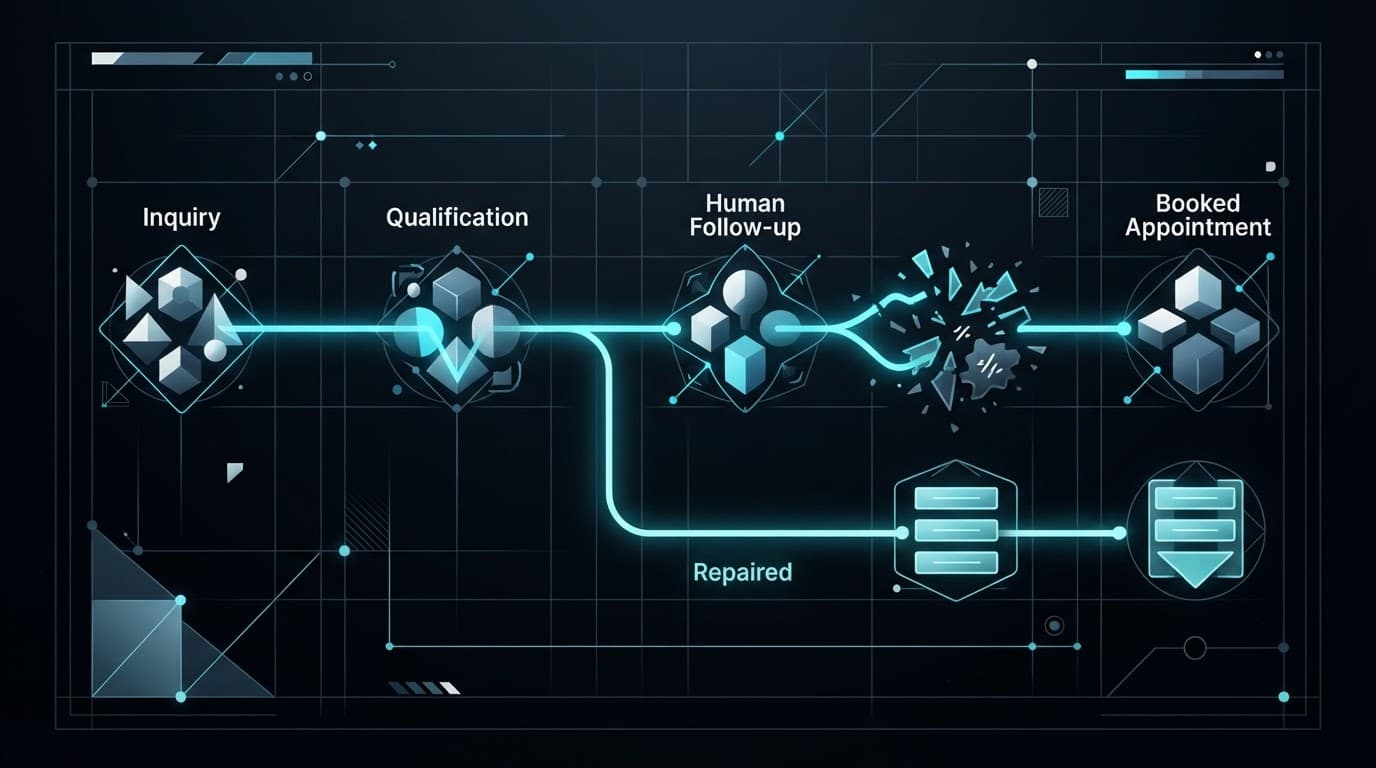 ### The Symptoms of a Sales Process That Is Not Ready for AI
Warning signs are easy to spot: nobody can name the response-time target, several people assume another person will call, and the CRM has dozens of optional fields nobody completes. Other problems include weak offers, inconsistent service areas, and follow-up that stops when someone gets busy.
A conversational AI interface may collect more information, but it won't repair those gaps. Natural language processing can interpret a response, but it can't define what makes an opportunity qualified when the business hasn't set that standard.
The Process Rules to Define Before Automating
We recommend setting a minimum operating standard first. Robotic process automation suits deterministic record updates or handoffs only after those rules are defined. It doesn't replace qualification judgment.
- Define the target customer, service area, offer, and disqualifiers.
- Set sales stages, required lead fields, routing rules, and response service levels.
- Document escalation paths, follow-up timing, and the evidence needed to call an opportunity qualified.
Each rule gives the workflow an action it can perform and a result you can audit.
Where AI Sales Automation Creates Real Leverage
The strongest uses of AI sales automation are narrow, repetitive, and measurable. They reduce the gap between inquiry, qualification, routing, and a salesperson's meaningful response.
Sales automation platforms can connect inquiry receipt, routing, qualification, and follow-up. They’re useful only when each step has a clear owner and measurable outcome.
That can mean instant receipt confirmation, basic intake, correct assignment, message summaries, and reminder tasks. It does not mean handing a complex sales conversation to an autonomous agent.
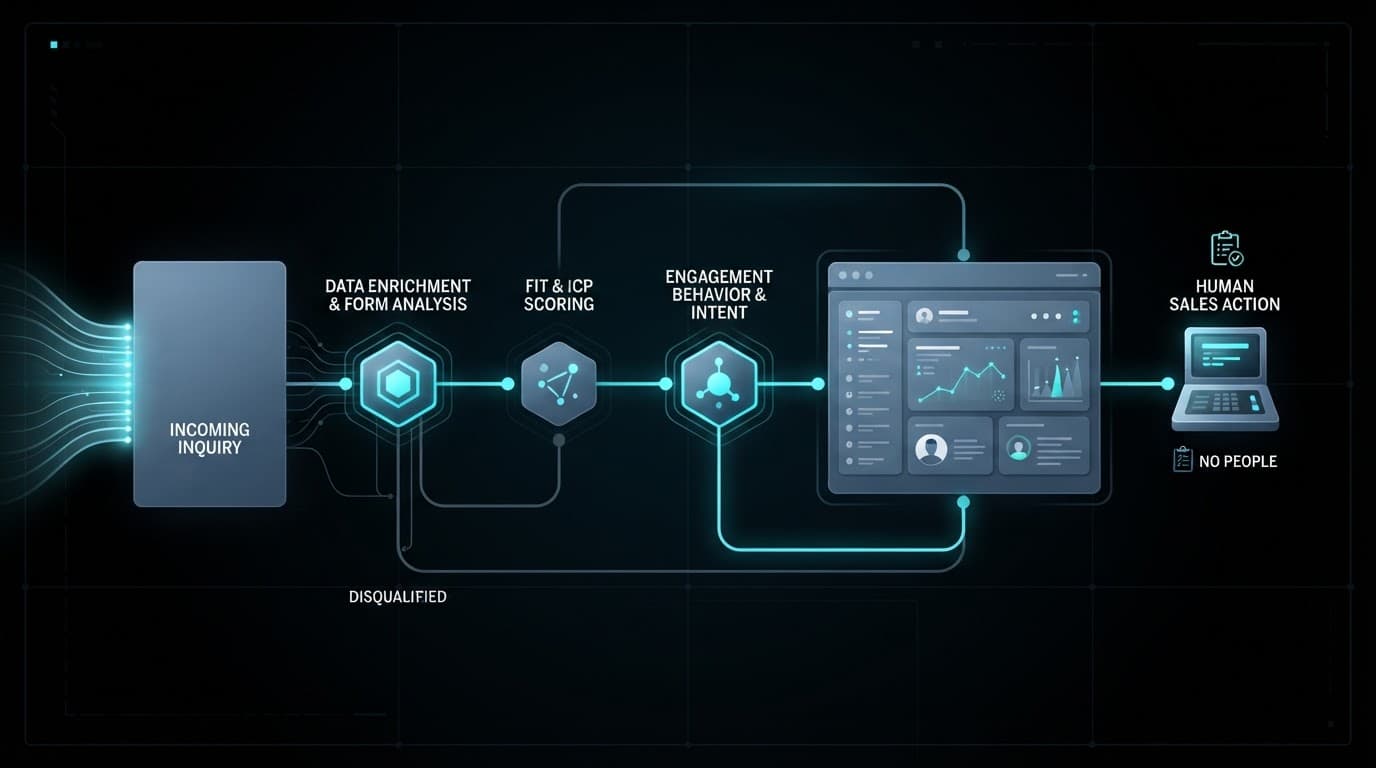 ### Speed to Lead Starts With Useful First Contact
The Lead Response Management research associated with MIT Sloan's James Oldroyd and InsideSales.com found that qualification odds dropped 21 times when the first call moved from five minutes to 30 minutes. That widely cited result applies to qualifying inbound leads, not guaranteed closed revenue, as explained in this lead response time research summary.
AI can confirm receipt, state when a person will respond, capture basic context, and notify the right owner within seconds. However, an automated acknowledgment is not meaningful human contact. Your team still needs a clear deadline for the first real conversation.
AI Lead Qualification Should Collect Only What Changes the Next Step
Effective inbound lead qualification starts with questions that affect the next action. For a service business, these often cover location, service type, urgency, timeline, and budget range.
Conversational AI can ask context-specific questions without forcing every prospect through the same form. Lead scoring can help prioritize responses, but it shouldn’t replace documented qualification criteria.
Long conversational forms often create false confidence. They frustrate strong prospects and can confuse urgency with fit. A water-damage contractor needs different routing logic than a prospect asking about a future kitchen remodel.
CRM Automation Turns Conversations Into Usable Sales Data
AI can create leads, log calls and messages, summarize transcripts using natural language processing, draft follow-ups, detect duplicates, update stages, and create tasks. Lead enrichment can append approved context to a record, including verified b2b contact data for some commercial service lines. However, enrichment alone doesn’t make a lead qualified.
Those actions improve reporting only when your required fields and definitions stay consistent. Data quality still depends on clear ownership, validation rules, and regular review.
Then you can see where performance changes: median response time, contact rate, qualification rate, appointments, show rate, close rate, and revenue. Our CRM and lead follow-up automation work focuses on connecting those records to actual sales ownership.
Repair the Sales Process Before Adding More Automation
Marketing, lead capture, CRM, follow-up, and sales calls are one customer acquisition system. A good ad campaign can't recover revenue lost after a missed call, and a better website can't solve unclear routing.
Map the Journey From First Inquiry to Closed Revenue
Coordinate multichannel outreach across search results, ads, forms, phone calls, referrals, and returning customers. Don't treat every channel alike or automate every response the same way.
Continue through qualification, appointment, estimate, proposal, close, and post-sale handoff as part of disciplined sales pipeline management.
For example, a roofing contractor might respond quickly to a storm-damage form, but lose the job when the office fails to assign the estimate within the promised window. Find the waiting points and the moments where two people assume the other owns the next action.
Set Owners, Service Levels, and Escalation Rules
Every lead needs one owner and a response target. Separate an automated message from a human response, then define what happens after missed calls, after-hours inquiries, urgent requests, poor-fit leads, and stalled conversations.
A workflow without escalation can hide a sales failure behind an apparently successful automated response.
High-value and urgent leads should alert a manager when the owner misses the target. Prospects who ask for a person need a direct handoff, not another automated question.
Clean the CRM and Measure the Handoffs
Remove duplicates, standardize fields, define lifecycle stages, and record timestamps for lead creation and first AI or human response. This revenue intelligence can reveal where inquiries stall and revenue is lost.
Use median response time because averages can conceal a group of leads waiting far too long. Review sales intelligence by source, service type, and salesperson to guide staffing, training, and follow-up decisions.
More leads don't always improve performance. If qualification or close rate falls, extra traffic may raise customer acquisition cost while producing less revenue. A Free Lead Leakage Audit can expose where inquiries stop moving forward.
What Can Go Wrong When AI Automates the Wrong Process
Fast responses can still be wrong. Machine learning algorithms may repeat incorrect routing or assumptions at scale. Automation can ask the same questions, misroute leads, quote inaccurate pricing, overpromise availability, or contact someone too often.
Fast Responses Can Still Produce Bad Sales Outcomes
A workflow may use lead scoring to qualify a vague inquiry, even when service area, scope, or urgency data is incomplete. Natural language processing can interpret a message without understanding the full business context. That creates CRM clutter and distorts conversion reporting.
Keep human review for complex, high-value, sensitive, or regulated situations. Sales judgment matters most when context changes the recommendation or commitment.
Avoid Building Autonomous AI Agents Before Proving the Basics
Start with bounded workflows, such as first responses, missed-call recovery, appointment reminders, lead routing, or follow-up prompts. Don't expand into sales prospecting, outbound sales outreach, or sales email campaigns until targeting and messaging are proven. Otherwise, automation can scale weak assumptions and inaccurate communication.
Generative AI tools can draft messages or summarize conversations, but those outputs still require approval. Use conversation limits, audit logs, clear handoff language, and an obvious opt-out path. These safeguards protect both the prospect and your team.
Use AI to Support Salespeople, Not Hide Weak Management
AI cannot solve poor pricing, weak sales training, unclear service areas, or absent accountability. It can show managers where those issues appear.
Use AI to support sales call coaching, then review outcomes by lead source, service type, and salesperson. Coach the actual bottleneck, whether it is slow response, weak discovery calls, poor follow-up, or an offer that doesn't fit demand.
A Practical AI Sales Automation Rollout for Service Businesses
A full overhaul of sales automation platforms creates too many moving parts to diagnose. Start with the most expensive repeatable failure and establish a baseline before launch.
Start With One High-Value Workflow
Choose one bounded workflow automation use case, such as inbound response, missed-call recovery, appointment booking, estimate follow-up, or lead routing. Pick based on lost revenue, frequency, repeatability, and ease of measurement.
Record your current median response time, contact rate, qualification rate, and booked opportunity rate. Without a baseline, higher activity can look like improved sales productivity.
Test the Workflow Against Real Business Scenarios
Test complete forms, vague inquiries, duplicate leads, after-hours messages, urgent requests, out-of-area prospects, price shoppers, existing customers, and requests for a human. Review how natural language processing handles each case, along with the CRM record created behind it.
For connected website, CRM, follow-up, SEO, paid media, and sales engagement platforms, see Autonomics Agency Home / Services.
Scale Only When the Numbers and Handoffs Improve
After a defined test period, compare baseline performance with post-launch results. Review response time, contact rate, qualification rate, appointments, show rate, closed revenue, and cost per opportunity.
Sales forecasting can support later planning, while predictive analytics may guide future prioritization. Neither replaces baseline conversion and revenue data.
Introduce autonomous AI agents only when data quality, ownership, and human follow-up remain reliable. Add robotic process automation for deterministic back-office steps only after the core workflow is proven. More automation is useful only when it produces better handoffs.
Frequently Asked Questions
Does AI sales automation replace salespeople?
No. Natural language processing can support repetitive intake and summaries, but it doesn't replace judgment. Even autonomous AI agents can't build trust, assess context, handle objections, or make accountable commitments.
Which workflow should a service business automate first?
Start where lead leakage costs the most and the work repeats often. In many businesses, that is inbound response, missed-call recovery, or estimate follow-up.
How long should an AI workflow test run?
Run it long enough to collect meaningful data from real conversations under normal business conditions. Review errors weekly, then compare results with your pre-launch baseline.
Should AI answer pricing questions?
It can share approved general guidance when the offer and pricing rules are clear. Keep custom pricing, exceptions, and complex scopes with trained staff.
What metrics show whether automation is working?
Look beyond message volume. Median response time, contact rate, qualified opportunities, booked appointments, show rate, close rate, revenue, and cost per opportunity reveal whether the workflow improves sales outcomes.
Build the Process First, Then Automate It
AI sales automation is most useful when it executes a process with a clear purpose, owner, and rule set. Software can move work faster, but it can't repair a broken handoff or measure success on its own.
Find the largest point of lead leakage first. Repair that handoff, automate the repeatable work around it, and measure qualified revenue while keeping the focus on qualified conversations, booked revenue, and a better customer experience.